
I May Have Undercounted
How many gun cultures are there, anyway?

Almost a decade ago, at the 2018 Rangemaster Tactical Conference, I had a funny interaction with one of the presenters, the late William Aprill. It went something like this:
Aprill: “Gun Culture 2.0, eh?”
Yamane: “Yep.”
Aprill: “I thought we were on Gun Culture 4.5 by now.”
For years I have been trying to forestall even talk of a Gun Culture 3.0—at least until I can finish my book on Gun Culture 2.0.
But speculation about the evolution of gun culture beyond the current self-defense-oriented version persists. For example, I’ve noted recent media interest in the present/future of gun culture by the New York Times and the Danish publication Politiken.
In my most comprehensive treatment of Gun Culture 2.0 to date, I conclude with a cautionary note:
The evolution of gun culture I sketch in this article should be viewed as a historically informed heuristic device. Like all heuristic devices, it is a conceptual tool that reduces the complexity of reality to facilitate exploration and analysis, so we must guard against oversimplification or reification of concepts like Gun Culture 2.0.
Rather than engaging in the challenging practice of predicting the future, there is a lot of work to be done to better understand the history of guns and gun culture in America.
Enter Gun Websites. They are proposing nine generations of American firearms culture, based on the co-evolution of “technology, laws, media, social acceptance, concealed carry, competition shooting, and industry growth.”

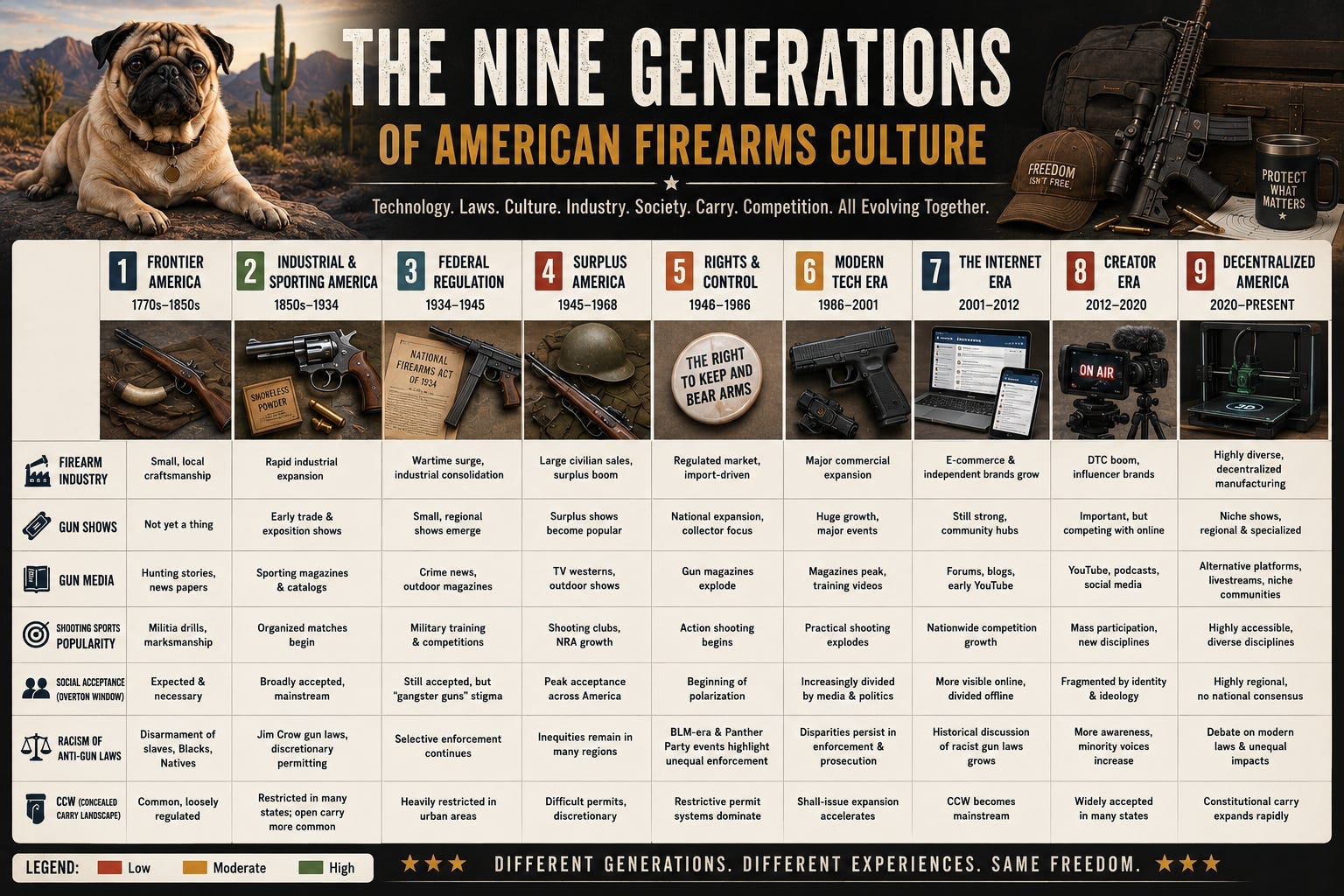
The Substack post “Nine Generations of American Firearms Culture” explains the framework and details each generation. But as usual, Gun Websites has created a couple of detailed graphics that summarize the perspective.
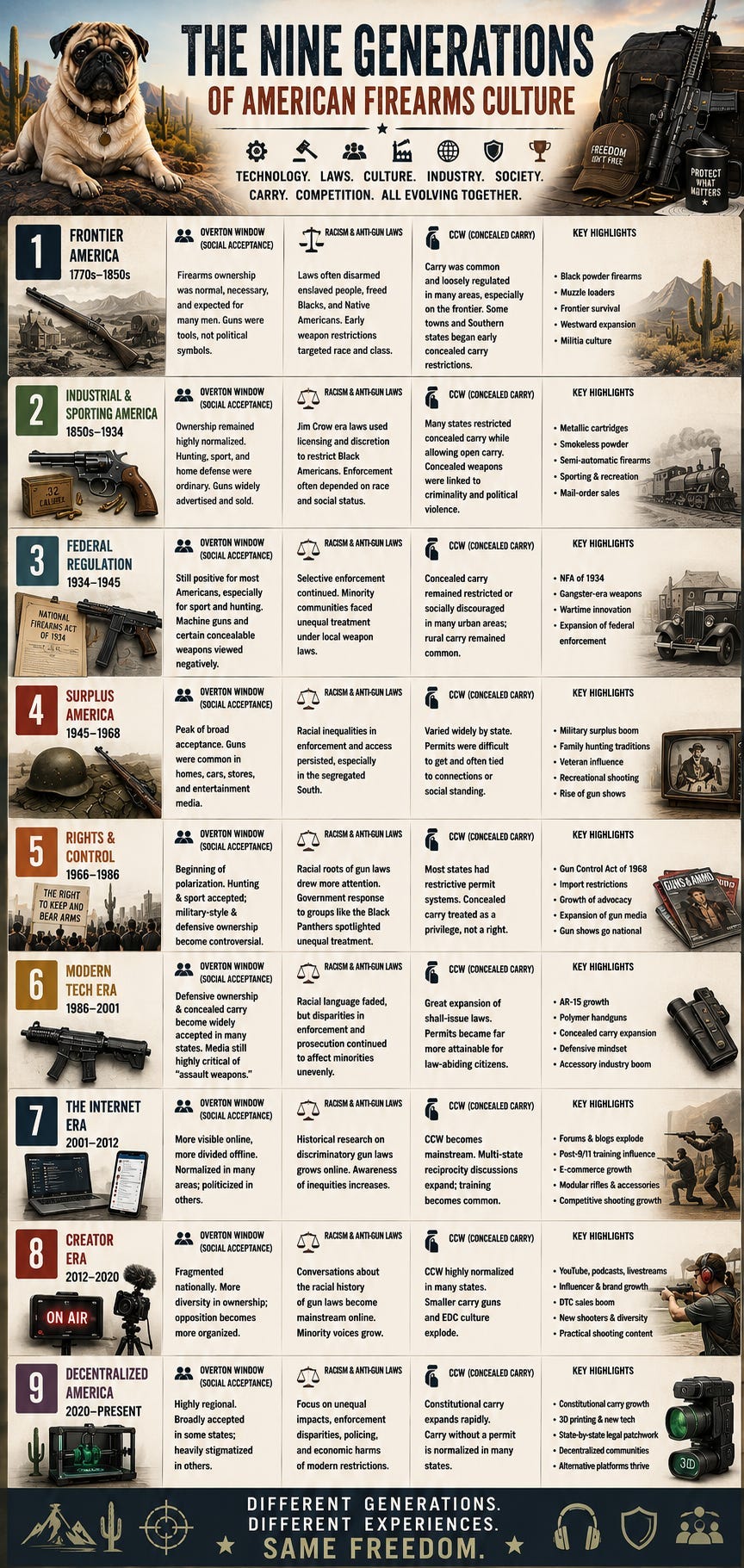
Far from finding this nine-generation framework threatening to my work on Gun Culture 2.0, I find it very fruitful in thinking about the complexity of American gun culture I’ve always recognized.
What I find most interesting about the nine-generation model is its granularity. Where my framework paints with a broad brush, Gun Websites traces finer-grained shifts across two centuries of firearms history.
I'm seriously considering incorporating this into my Sociology of Guns seminar this fall. Go read the Gun Websites post, look at their graphics, and tell me what you think. Should I use it in Sociology of Guns this fall?
"Culture" internal to the gun owning community different from the broader historical and cultural things happening around it. So many things wrong with this analysis, too many to put in a comment. I will email you a longer document.
Man, the AI slop graphics there are just flat-out distracting.
LOL