
Shared Targets: Supporting Collaboration across Gun Experts and Firearms Researchers
A beacon of light in a sea of heat

I had the great good fortune recently to attend a one-day, invitation-only symposium at Arizona State University.
The event was co-sponsored by Jennifer Carlson’s Bringing Research and Innovation into the Debate on Guns in Society (BRIDGS) Initiative at Arizona State Univeristy and Emmy Betz’s Firearm Injury Prevention Initiative at the University of Colorado Anschutz Medical Campus. I’m grateful to both organizations for providing the funding to bring me and others to Tempe for this important conversation.

The symposium brought together 25 people to consider the theme: “Shared Targets: Supporting Collaboration across Gun Experts and Firearms Researchers.”
(Note: To allow people to speak freely, the event was conducted off the record and we agreed not to disclose who participated without their permission, so I am generally not quoting anyone or naming names here.)
Of the 25, I would say that roughly 7 were “gun experts” and 18 were “firearms researchers,” though a few of us were unsure whether we were supposed to be representing the “firearms community” or “academia.” (There was also some robust discussion of what “the firearms community” even means.)
As I have frequently noted, I have one foot in each of these two worlds, and this status of being neither here nor there (or, more positively, being both here and there) allows me to act as a translator between them. There were probably 4 others in attendance who were similarly positioned in various ways to act as bridges between the two communities.
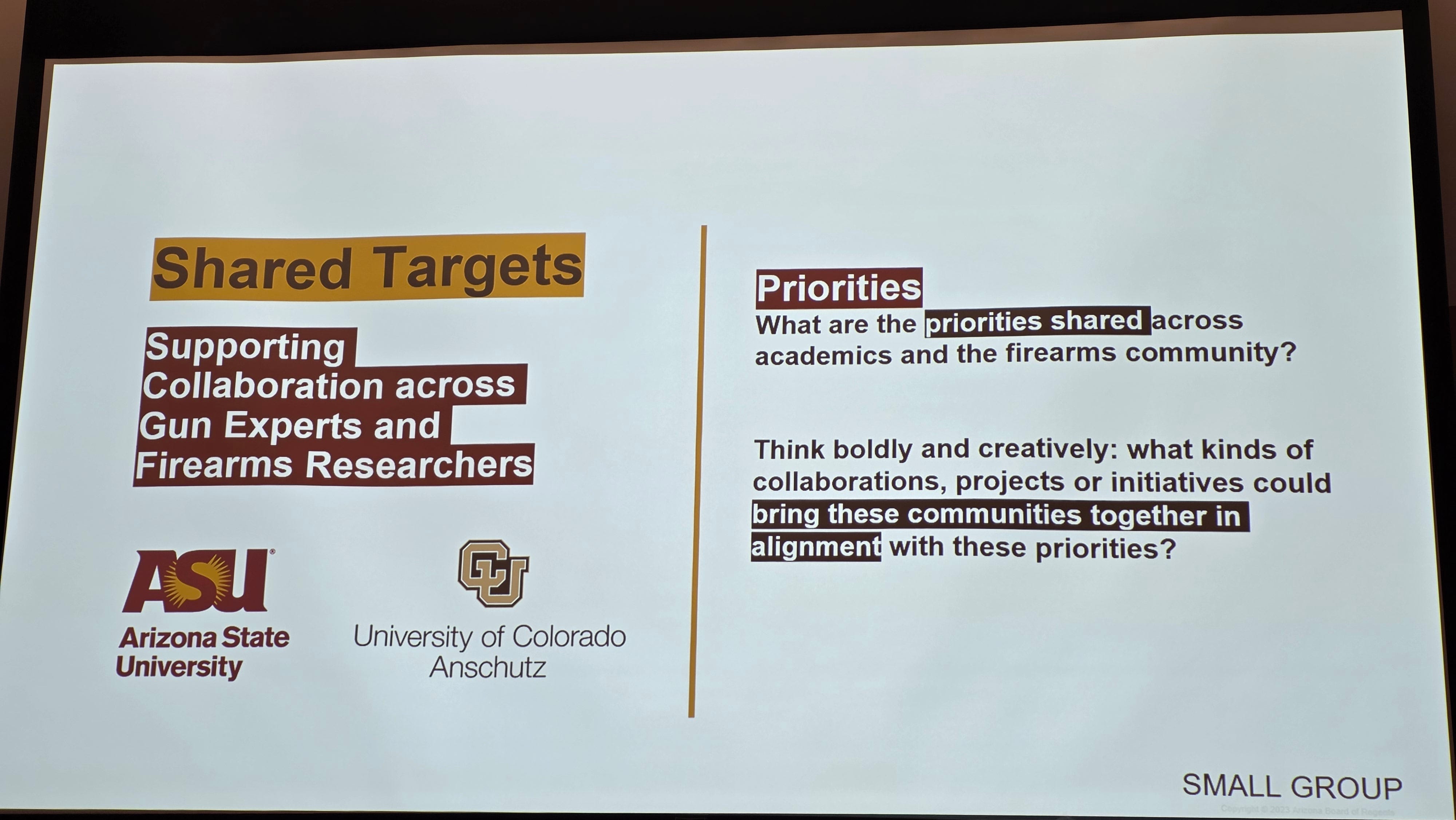
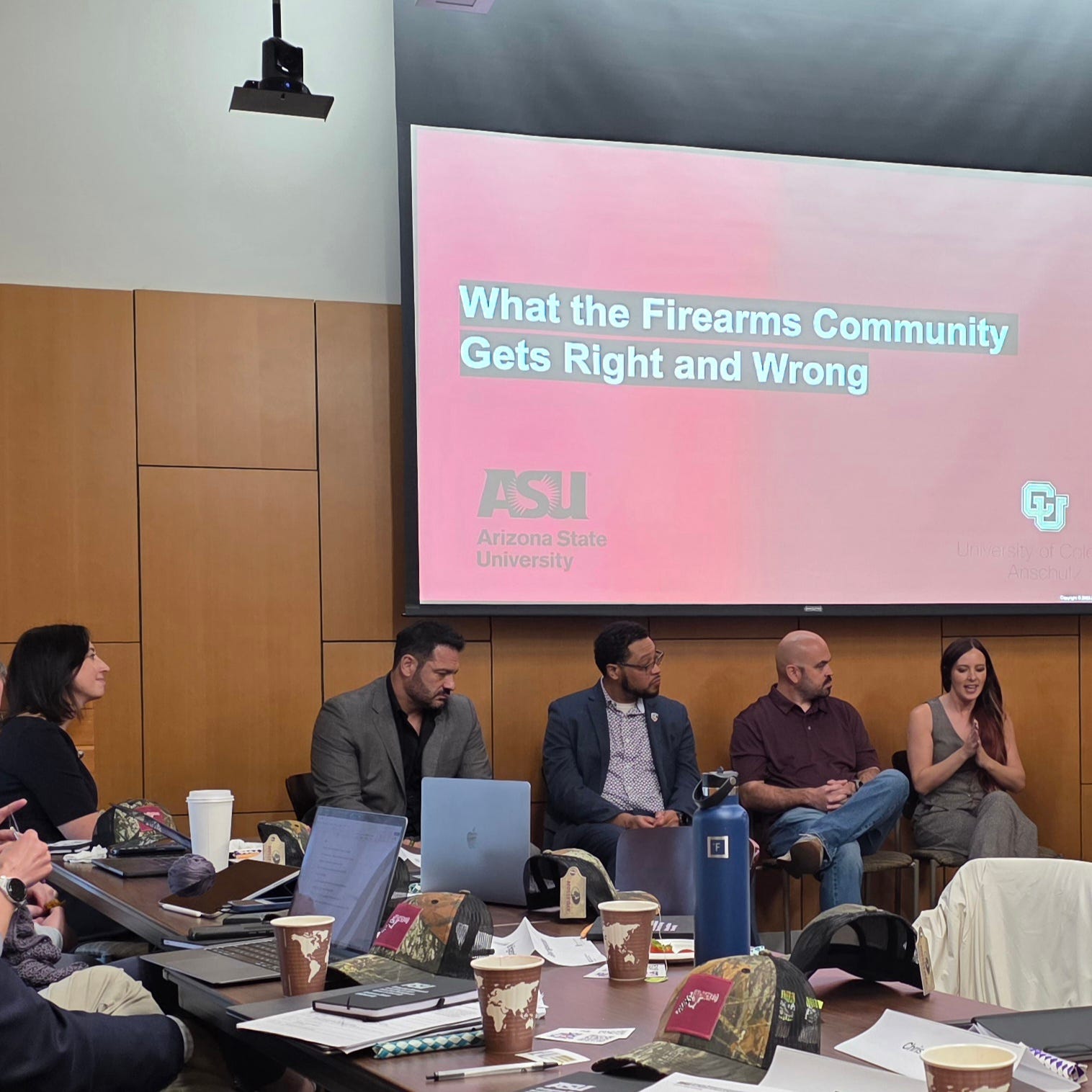
As is the case with most successful conversations about guns across differences, the symposium was well-structured. After the opening remarks, there were two panels with 5 participants.
The first panel was on the topic of “What the Firearms Community Gets Right and Wrong.”
The selection of the gun experts to serve on this panel was sublime because they all represented the firearms community well, but from very different perspectives (from left to right)
Michael Sodini, founder of Walk the Talk America
Chad King, gun trainer and president of the Black Bottom Gun Club, Detroit’s chapter of the National African American Gun Association
Edgar Antillon, co-founder and president of Guns for Everyone National
Ashley Hlebinsky, historian of and public educator about firearms, consulting through The Gun Code
If you don’t know about the work these individuals and organizations are doing, you should!
I was on the second panel to discuss “What Academia Gets Right and Wrong.” I will be posting my remarks here later this week, so stay tuned.
Following these panels, there was a short session on “Building Trust in Research,” led by two scholars who have successfully done so. We concluded with small group discussions on several questions prepared for us.


I don’t know where this project will go because I am not an organizer or funder of the work. It could become a recurring event with the same or different people, or lead to a statement of ideas or principles for the individuals involved to join as the first signatories. I’m sure there are some more entrepreneurial spirits out there who can take the lead on this.
Even if this specific work ends here, though, I think some significant progress was made. People heard each other and built relationships that I hope will last.
A true highlight for me was seeing, throughout the day, encouraging signs of the kind of intellectual humility, curiosity, and empathy that are too often missing from our great gun debates.
I sometimes converse with Jenny and Emmy (and we exchange email and follow each other on X) so I am not surprised they would be working on ecumenical discussions. I really am curious as to the others. In confidence, of course.
I appreciate the good intentions here, but the conversation is adrift if it doesn't acknowledge an important truth: Michael Bloomberg has pumped untold millions of dollars into the academic sphere, which has tilted much of the "research" there towards supporting its preordained corporate conclusions (the master gun control narrative that would be achieved through a combination of thick bureaucracy and broad prohibitions), instead of approaching the research with wide-open eyes and a willingness to follow the data. Without this bias being clearly put on the table and acknowledged, I have a hard time giving credence to the opinions of those on the take.
That's why I carefully pick and choose what bits of academia I bring into my world—and, as I've said before, why I was happy to invite you in, David.