

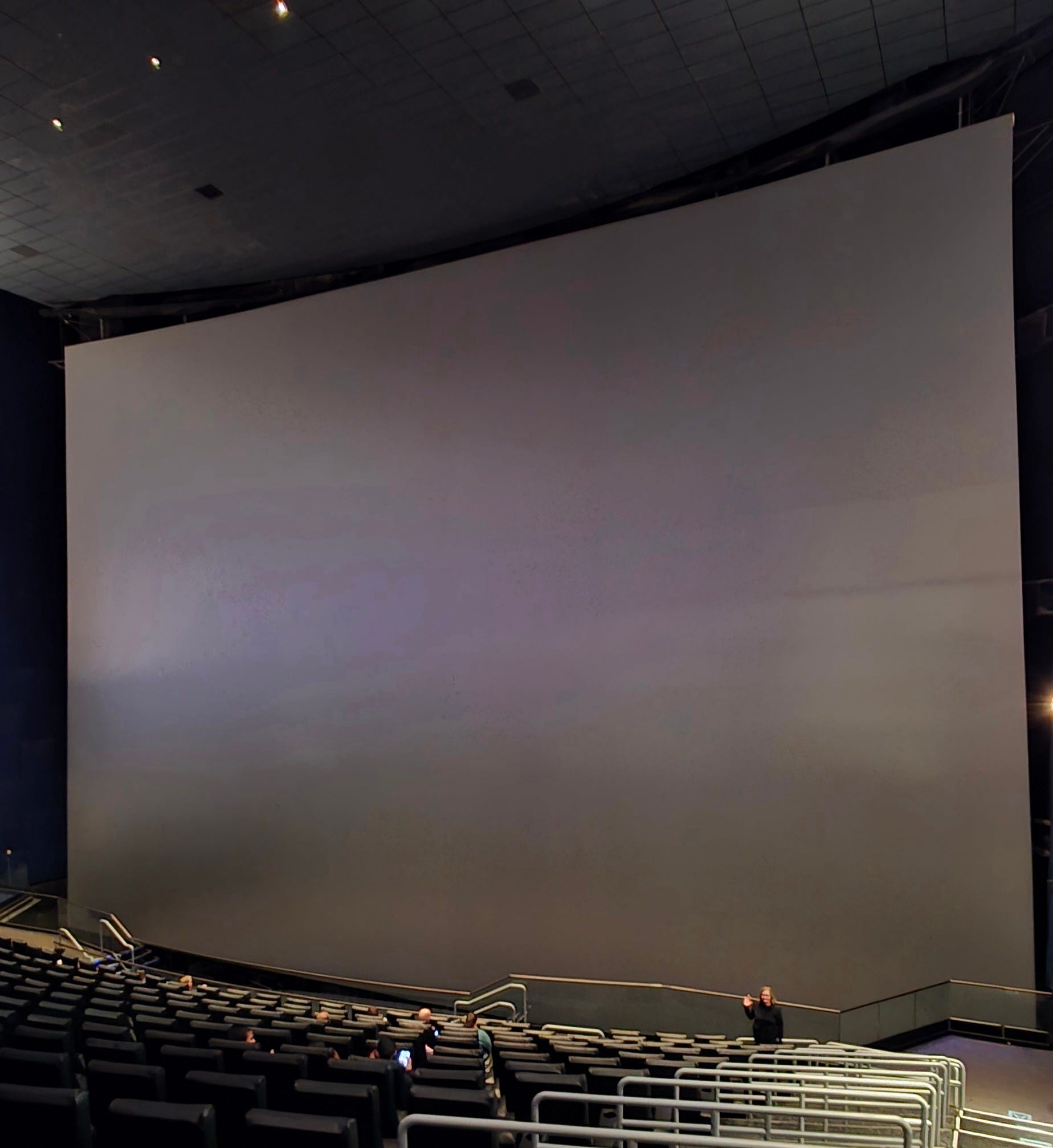
I finally saw Christopher Nolan’s Odyssey this week. In full 70mm IMAX at the San Francisco Metreon theater.
Briefly, I can recommend the movie in general, and the 70mm IMAX version is incredible. Watching a screen that is 76 feet tall by 98 feet wide from the second row is another story. Not recommended.
The critical response to Nolan’s movie from experts on Homer’s epic poem — notably Emily Wilson’s takedown in The London Review of Books — got me thinking about the difference between translation and adaptation.
It seems to me that a translator’s job is to render the author’s text in a different language as faithfully as possible. Of course, every translator also brings their own perspective to the table (see below), but I imagine within limits.
Christopher Nolan’s movie is his adaptation of Homer’s story. It makes no claim to fidelity, as far as I know. Nolan’s Odyssey tells us as much about Nolan as it does about Homer’s Odyssey.
In my previous post about how I caught Odyssey Fever, I highlighted the first sentences of five different translations of Homer’s Odyssey.
When I originally posted about these translations on social media, I asked people to share their favorite translation if it wasn't one of the five I noted. My college friend, Boaz Roth, said his favorite translation was his own.
Here is Boaz’s translation:
A man, a multifaceted man, who wandered very much—
after he sacked the sacred city of Troy—relate to me, muse.
I like this translation quite a lot, especially the repetition of man in the opening words. It both reinforces the idea of Odysseus as a man (a mortal), and highlights his multifaceted nature.
Below you can read Boaz’s explanation of how he got here.
Dr. Yamane’s First Homeric Greek Lesson
by Boaz Roth1
To best understand how to translate the first two lines of the Odyssey, let’s begin with English. Consider this innocuous sentence.
Dr. Yamane loves Paul.
A simple, grammatical analysis reveals the following: the verb is loves, and the subject, the person who loves, is Dr. Yamane. Paul is the object of the loving. Here is the sentence with its grammatical elements labeled above them:
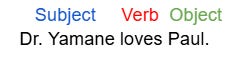
Now comes a mystery: how do we know which word is the subject and which word the object? The answer is pretty simple—geography. In English, we’re accustomed to seeing the subject come before the verb and the object arrive after it. In fact, look what happens if we flip Dr. Yamane and Paul.
Paul loves Dr. Yamane.
Now we have a new subject—Paul—with a new object—Dr. Yamane—and have distorted the meaning of the original sentence. All the words are the same, but they take a different meaning due to their relative geography.
Let’s consider one other English element before confronting Homer. What if we wanted to say that Dr. Yamane loves Paul more than anything in the world (even more than a bottle of bourbon!) but couldn’t add any words? We could try this combination.
Paul Dr. Yamane loves.
Unless you’re related to Yoda, you’re probably a bit confused: Paul moves to the head of the sentence to signal his importance, but with Dr. Yamane still right in front of the verb, we’re starting at an awkward mess.
Grammatically, it looks like this:
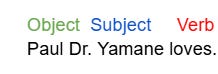
(Note: Adding a comma after Paul would make matters worse, as it suggests we are addressing Paul and telling him that Dr. Yamane loves.)
Its place in the sentence dictates the work of an English word. This is a virtue of English. The reliance on geography, however, limits English expression: we really can’t make Paul the most important word in the sentence when he’s the object. Moving Paul to the front of the sentence to receive extra attention muddies the sentence’s meaning. The big takeaway: geography creates meaning in English. Now let’s examine Homer.
Unlike English, ancient Greek is an inflected language, a language with changing (inflected) forms. Ancient Greek’s nouns and adjectives get their meaning from their endings (verbs from both ends and beginnings). For many, identifying and decoding the endings poses the initial difficulty in learning Greek. Generally this task takes students a month or so to master.2
So ancient Greek is the opposite of modern English. Ancient Greek requires us to identify lots of endings (English not many), but Greek breaks free from geography, so any word can go anywhere in the sentence. Writers of ancient Greek have more freedom to express themselves by employing word order in ways English writers can’t.3 Big takeaway number two: in ancient Greek, geography doesn’t impact usage but enhances expression. Now take a look at the first two lines of the Odyssey (in poetry, it’s helpful to discuss lines rather than sentences).
ἄνδρα μοι ἔννεπε μοῦσα πολύτροπον, ὃς μάλα πολλὰ
πλάγχθη, ἐπεὶ Τροίης ἱερὸν πτολίεθρον ἔπερσεν:
Recall that our previous English sentence—Paul Dr. Yamane loves—was awkward because starting a sentence with an object created cumbersome English, despite Paul’s importance in this sentence. Homer doesn’t have that issue: ἄνδρα (andra meaning “man”) is an object just like Paul. And because it starts the line—and a 12,000-line poem for that matter—we recognize its great importance. Without geography to hold him back, Homer can express himself through word order in a way we can’t.
Now we encounter problem number one facing any translator: how faithful to remain to Homer? Should our translation begin with andra, or should we be dutiful to English readers and start with the main subject and verb? Maybe we’ll change our minds later, but let’s begin our translation with man (or since English loves articles, A man) and see how that decision impacts our next choices.
To review, let’s examine part of the poem’s opening with grammar prompts above and dictionary definitions below:
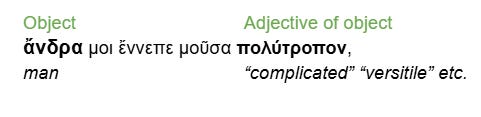
The word πολύτροπον describes the man,4 even though they’re separated by three other words (another huge difference in these languages, as English adjectives always come before the nouns they describe). Anyway let’s put the two words together as so: A multifaceted man….
Why multifaceted? The word πολύτροπον (polutropon) has two parts to it. The first is πολυ from which we get the stem poly- in words like polymath or polygon, and it means many. The other part, τροπον, comes from a verb that means to turn. That’s why a default translation has been “A man of many (twists and) turns.” English options abound here, and translators’ choices arise from what they think of Odysseus. If one is warmly disposed to Odysseus, perhaps resourceful fits the bill. If he has blemished our views by his actions, maybe we select deceitful. To avoid taking a stand, let’s try multifaceted.5
Even though it makes sense to add the main subject and the verb, let’s hold off for a moment and consider the bolded words.
ἄνδρα μοι ἔννεπε μοῦσα πολύτροπον, ὃς μάλα πολλὰ
πλάγχθη, ἐπεὶ Τροίης ἱερὸν πτολίεθρον ἔπερσεν:
These words mean “who wandered very much,” and they all refer to the andra. So how about we glue them on to what we’ve started?
A man, a multifaceted man, who wandered very much….
The next addition is straightforward. The bolded words below mean “after he sacked the sacred city of Troy,” and they also refer to the man from line one.
ἄνδρα μοι ἔννεπε μοῦσα πολύτροπον, ὃς μάλα πολλὰ
πλάγχθη, ἐπεὶ Τροίης ἱερὸν πτολίεθρον ἔπερσεν:
So now we have:
A man, a multifaceted man, who wandered very much, after he sacked the sacred city of Troy…
Now let’s return to what we skipped: the main subject and verb of the two lines.6 Bolded are the words not yet part of our translation.
ἄνδρα μοι ἔννεπε μοῦσα πολύτροπον, ὃς μάλα πολλὰ
πλάγχθη, ἐπεὶ Τροίης ἱερὸν πτολίεθρον ἔπερσεν
Here are the words with dictionary entries below:
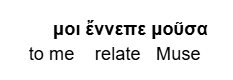
That particular order sounds robotic, so to make things more comfortable to English ears, maybe we should try relate to me, muse,
If we like that adjustment, here’s the result of our first attempt:
A man, a multifaceted man, who wandered very much—after he sacked the sacred city of Troy—relate to me, muse.
Since Homer writes in lines and not prose sentences, let’s chop up these words into two lines of relatively equal length:7
A man, a multifaceted man, who wandered very much—
after he sacked the sacred city of Troy—relate to me, muse.
So we have a first draft of a translation. On the one hand, it preserves the poem’s beginning really well—Homer’s lines start with man as do ours. And even though this version delays the grammatically essential elements until the end (the subject and the main verb) that move increases the lines’ tension (like Odysseus’s bow!). Notice, however, that other than man for andra at the start of our work, this translation does not dutifully follow Homer’s word order.
Moreover, to make this version work, the translation needs three commas and two dashes, all of which will certainly slow things down. Here is another element a translator needs to consider: speed. While the original Homeric text had no punctuation, scholars have enough clues about where to add stops. Here Homer only needs commas around ὃς μάλα πολλὰ πλάγχθη.8 But the lines contain no signals about further punctuation. This single detail forces translators to think about the big issues of their work. Picture a spectrum with Homer at one end and a modern reader at the other—on which side do we lean and how long do we stay in that spot? Does an excellent translation insist we never “move” throughout our work or do we shift about depending on circumstances? Perhaps every translator, ultimately, serves many masters.9
Obviously, we need to be πολύτροπον—multifaceted or maybe complicated—as we translate. And as for Odysseus so maybe for us: by the time we complete this journey, perhaps we will not entirely resemble the people who started it.
I’m grateful to my friend for taking the time to give me a Greek lesson and offer his own excellent translation of the opening of Homer’s Odyssey.
So, your turn now. Boaz gives us a “multifaceted man.” Mendelsohn a man “who had so many roundabout ways.” Wilson a “complicated man.” Mandelbaum “the man of many wiles.” Butcher and Lang the man “so ready at need.” Pope the man “for wisdom’s various arts renown’d.” Nolan, according to his critics, gives us none of these.
Which version of Odysseus rings truest to you?
Notes
Boaz Roth has taught a range of classes in English, Greek, and math at Thomas Jefferson School in St. Louis since 1994. He’s been the athletic director and varsity basketball coach for over 25 years. He has a Bachelor of Arts in philosophy and economic theory from The American University and a Master’s degree in liberal education from St. John’s College.
That said, after getting past this challenge, learning Greek is not much harder than learning anything else. After two months of study, my students are reading lines from the Iliad.
Well, most writers. Check out Macbeth, II, i, 73-74 (Folgers edition). Here Shakespeare manages to pull off the feat of writing a Greek sentence in English.
These words belong to different declensions—the buckets in which nouns and adjectives are dumped— but actually have the same endings, just with different letters. If we were parsing, we’d say that both are accusative, masculine, singular. No worries if you are new to Homeric Greek!
Emily Wilson chose complicated.
The verb is an imperative, which is a command. By its form we know it’s a second-person singular imperative. Don’t worry about that part! Just know that you’ve used these hundreds of times. If you’ve ever said anything resembling “Sit down” you’ve used an imperative. The subject of the verb is an implied “you.”
Homer’s line will contain anywhere between seventeen and twelve syllables (twelve is super-rare: I believe only four of his 28,000 lines have that minimum amount, while the seventeen-syllable line shows up often, as do sixteen, fifteen, and fourteen syllables lines). Metered English poetry typically has eight or ten syllable lines. Here comes another huge translating decision: should our translation sound more like English poetry (or, yuck, prose) or something closer to Homer’s work? Another complication: English poetry often places stressed syllables next to unstressed syllables (a concept that did not exist for Greek poetry). How “Englishy” poetic should our translation sound? Again, no “right” answer here! You can now see why multiple translations exist for the same work.
Lovers of grammar will know why: these words form a non-restricive, adjectival clause and need to be set off with commas in English.
Want to see a more conventional translation with the verb first? Try this one.
Relate to me, Muse, a multifaceted man who wandered very much
After he sacked the sacred city of Troy
Do you like this version more? Both attempts are “right,” but they each highlight something very different.
As a person who regularly reads English translations of Japanese writings, based on Chinese literature, with the original language being orally conveyed Pali, doing this sort of comparative analysis quickly became a habit. My better half always comments, how many copies of _______ ( fill in the blank with Heart Sutra, Diamond Sutra, Blue Cliff Record, etc…)do you really need?
Also being a patent attorney you quickly realize that one must engineer the language to achieve the desired result. Does a comma go here? What does that convey? What does that remove? Which result is more desirable? What happens if I use “ adjacent to” v. “Beside” v “on top of” or even “ functionally arranged in proximity to” . And that’s writing for highly technical reasons.
I always get a good laugh after seeing an English text document that I have carefully crafted translated into, for example Chinese or Finnish, or Russian, only to be translated back into English. It reminds me of the frailty of words and language.
Now add the layer of complexity called poetry and oral conveyance tradition in which the sound and cadence of the words affects not only the objective meaning, but also conveys the feeling / emotion / essence of the words. Not to mention embellishing changes by each story teller.
Take any English poetry and do the multiple translation game with Google Translate. Say take the first stanza of some work you may know by Robert Frost….
Two roads diverged in a yellow wood,
And sorry I could not travel both
And be one traveler, long I stood
And looked down one as far as I could
To where it bent in the undergrowth;
Notice the rhythm and cadence and word play. The feeling it conveys, the picture it paints in your mind.
Now translate to Armenian then to French and then back to English. This is what I got from Google translate….
Two roads diverged in the yellow wood,
And I regretted not being able to take them both.
Being a traveler among others, I stood motionless for a long time.
And my gaze wandered as far as it could reach,
Where it disappeared into the undergrowth
Notice the rhythm and sound and feeling has shifted. Yet the objective story is the same.
My point being, all translations are really adaptations from the original language to the next language. This is true even in highly precise and technical language. Given the oral tradition and poetry that created and eventually conveyed the Odyssey to us, and the embellishments each story teller may have added to it along the way, debating the fidelity to the original, IMHO, devolves into a literary argument akin to a theological argument about angels on a pin head.
Perhaps this most recent cinemagraphic telling of the Odyssey story (and its popularity) is more a reflection upon our current times and the story teller than we would like to openly admit.
German has a fixed order of 'W-questions.' When interpreting on the fly (which I've done informally) the original order sometimes can come through into English. When translating in writing (which I've done for hire,) a more natural rearrangement can be achieved. The use of clauses still offers some ability to retain the original emphasis -- as Herr Roth has done here.